
Jefferson Davis Parish Court Records After Arrest
A Jefferson Davis Parish arrest starts with jail booking, but the court case begins when a charging document is filed. The sheriff roster may show arrest charges, booking date, booking number, bond, and custody status. The court record is different. It is maintained through the 31st Judicial District Court, the Jefferson Davis Parish Clerk of Court, and the Jefferson Davis Parish District Attorney. The 31st JDC site states that the court has original jurisdiction over civil and criminal matters in Jefferson Davis Parish.
The court record can differ from the jail booking record because the District Attorney may amend, reduce, add, or decline charges. For custody and booking details, use Jefferson Davis Parish jail inmate records. For booking photos, use the Jefferson Davis Parish jail mugshots page. For formal charges, filings, and dispositions after an arrest, use the clerk, court, and DA access channels.
Find Court Records After Arrest
The inspected 31st Judicial District Court site provides court information, contact details, forms, rules, and online court platform material, but it was not a full public criminal case-search index in plain HTML. The official Clerk of Court site is a JavaScript app whose metadata describes public court-related information and records resources. Clerk Connect is a subscription portal for participating Louisiana clerks, but Jefferson Davis Parish was not visible in the public parish list reviewed during research. Do not assume an online Jefferson Davis Parish criminal case search is available through Clerk Connect without confirming participation.
- Start with the defendant's full name, arrest date, booking number, and charge from the sheriff roster.
- Contact the Jefferson Davis Parish Clerk of Court for filed criminal records or case-number help.
- Use the 31st Judicial District Court site for court contact, rules, forms, and hearing-related information.
- Contact the District Attorney for prosecution-side status, victim/witness help, or division routing.
- If a warrant or bond issue remains, confirm with the court or sheriff before assuming the roster amount is complete.
The 31st Judicial District Court website identifies Jefferson Davis Parish's district court role and court contact framework.
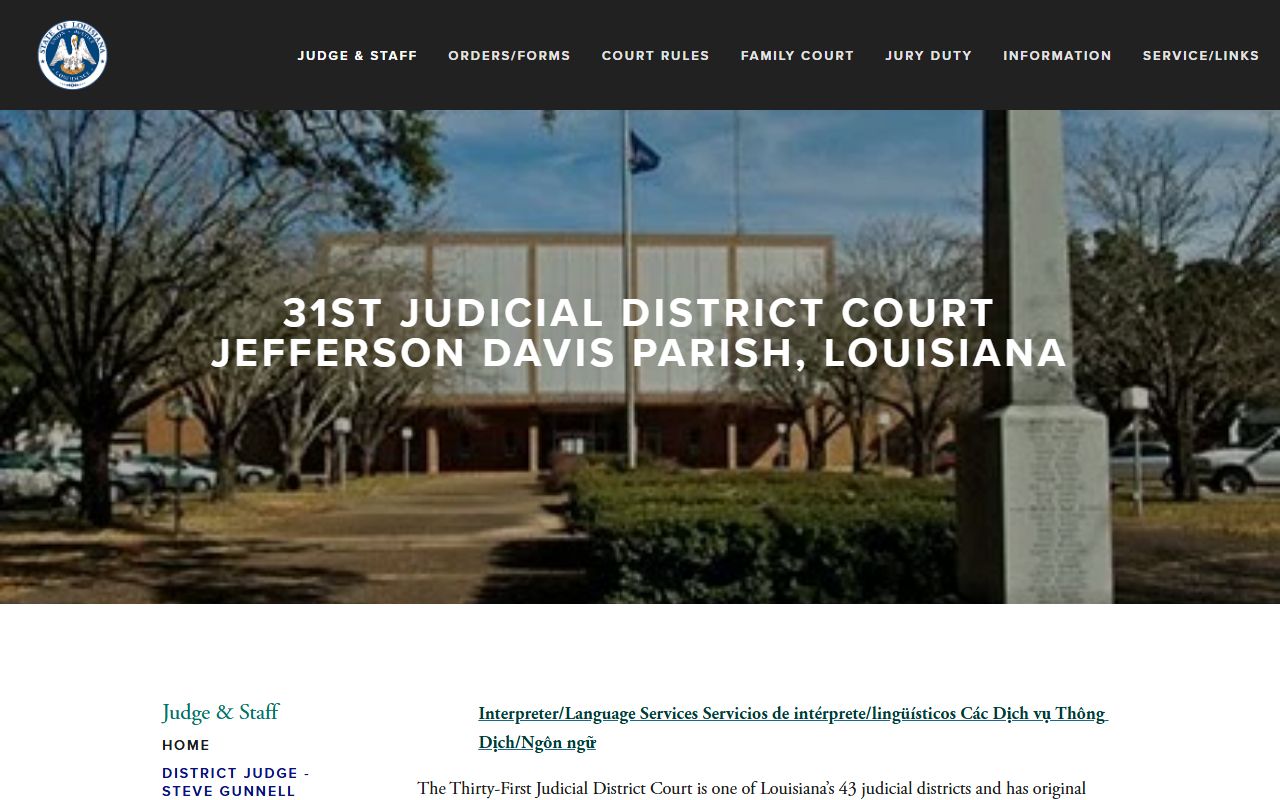
That court source should be paired with clerk records for filed criminal documents and with the DA for prosecution status.
Jefferson Davis Parish Court Offices
Three offices often matter after a jail arrest. The 31st Judicial District Court handles the criminal case path. The Clerk of Court files and maintains the court records. The District Attorney files and prosecutes charges. A caller should not expect one office to do every task. The clerk is the records custodian for filed case documents, while the DA handles prosecution decisions and victim/witness assistance.
Jefferson Davis Parish Clerk of Court
300 N. State Street, Room 106
Jennings, LA 70546
337-824-8340 / 337-824-1160
Filed court-record access and case-number help
Jefferson Davis Parish District Attorney
300 State Street, Suite 206
Jennings, LA 70546
337-824-1893
Criminal felony, misdemeanor, juvenile, traffic, and victim/witness divisions
Jefferson Davis Parish Case Search Limits
The research did not find a complete public criminal case-search table for Jefferson Davis Parish in plain HTML. That is an important finding. The 31st JDC site can orient users to the district court, but it should not be described as a full searchable criminal docket unless the court later publishes that feature. The Clerk Connect portal may include criminal cases for participating Louisiana clerks, yet Jefferson Davis Parish was not visible in the public parish list reviewed. Phone, in-person, or mail requests to the clerk remain the most reliable fallback for filed criminal records.
| Access Channel | Status Found | Use For |
|---|---|---|
| 31st JDC website | Court information and online-court resources, not a confirmed criminal case index | Judge, staff, forms, rules, and court contact context. |
| Jefferson Davis Parish Clerk | Primary filed-record route | Case numbers, bills of information, indictments, motions, minutes, dispositions, and copies. |
| Clerk Connect | Subscription portal, Jefferson Davis not confirmed in visible inquiry list | Do not rely on it without verifying current parish participation. |
| District Attorney | Prosecution office, not the court-file custodian | Victim/witness help, prosecution division routing, and pending-prosecution context. |
Charges Filed After Arrest
After a Jefferson Davis Parish jail arrest, the booking charge on the roster is only the first record point. Formal court charges are created through a complaint, bill of information, indictment, or other charging instrument. The DA can file charges that differ from the arrest charges. This is why a roster entry should be checked against court records before drawing conclusions about the actual case.
| Document | Who Uses It | What It Does |
|---|---|---|
| Complaint | Law enforcement or prosecutor | Begins or supports a criminal allegation after arrest. |
| Bill of Information | District Attorney | Formal prosecutor-filed charge used in many Louisiana criminal cases. |
| Indictment | Grand jury | Formal charge for serious matters when grand-jury action is required or used. |
Jefferson Davis Parish Charge Status
Charge status describes where an accusation stands in court. It is not the same as custody status. A person can be out of jail while a charge remains pending, or still in custody while charges are being reviewed. The DA site lists criminal felony, criminal misdemeanor, juvenile, traffic, pretrial intervention, and victim/witness functions, which reflects how cases can move into different prosecution tracks after the jail arrest.
| Status | Meaning |
|---|---|
| Pending | The case or charge remains open. |
| Amended | The prosecutor changed the charge. |
| Reduced | The charge was lowered to a lesser offense. |
| Dismissed | The prosecutor or court ended the charge without conviction. |
| Nolle prosequi | The prosecutor declined to proceed on that charge. |
| Conviction | A plea or adjudication resulted in a finding of guilt. |
| Acquittal | A not-guilty result. |
Bond After a Jail Arrest
Bond sits between jail custody and court records. The sheriff corrections page says jailers ensure inmates can see a judge within 72 hours of arrest, and article 230.1 sets the prompt judge appearance rule. If a judge gives bond, jailers update the file and help the inmate contact a bondsman. Bonds are accepted Monday through Friday from 8:30 a.m. to 3:30 p.m., and all bonds have a $30 paperwork fee. Property bonds may require added fees not listed on the sheriff page.
| Bond Type | How It Works Locally |
|---|---|
| Cash bond | Money is posted directly, and sheriff material says bonds are held until case closure. |
| Surety bond | A bondsman posts the bond; jailers help inmates contact one after bond is set. |
| Property bond | Property is used as security and may require additional fees. |
| Personal recognizance | Possible release without full cash or surety up front, but not described on the sheriff page. |
| No-bond hold | A separate hold, warrant, detainer, or court order may block release. |
Warrants and Court Records
The sheriff's Most Wanted page is not a full active-warrant database. It has search and sort controls, current and arrested filters, and a public tip-arrest count, but the inspected list area said content was unavailable at that time. Active warrant status should be confirmed through the sheriff, dispatch, or the issuing court. Sheriff dispatch is a key access channel because the research says dispatch operates NCIC and handles patrol communications.
Bench warrants can come from court failures to appear or violations of court orders. They may not appear on the sheriff's Most Wanted page. A person trying to clear a warrant should call the issuing court or sheriff, ask whether bond is set, and ask whether another hold exists. Federal fugitives are separate; Jefferson Davis Parish is in the U.S. Marshals Western District of Louisiana.
The sheriff's Most Wanted search controls include name search, current and arrested filters, newest and oldest sorts, and a Show All option. The page also reported 12 arrests from tips since July 30, 2013. That makes it useful for highlighted wanted persons and public tips, but it is not a warrant-clearance tool. A court bench warrant, city case, state probation hold, or federal warrant may require a different office.
Charges vs Convictions
A Jefferson Davis Parish arrest can create a jail record before any conviction exists. A charge is an accusation. A conviction is a court outcome after a plea, trial, or adjudication. The distinction matters for court records after arrest because a public charge may later be amended, reduced, dismissed, or resolved without a conviction.
| Charge | Conviction | |
|---|---|---|
| Meaning | Formal accusation or booking allegation. | Finding of guilt or guilty plea accepted by the court. |
| Timing | After arrest, booking, or prosecutor filing. | Later in the court case. |
| Can Change | Yes, by amendment, reduction, dismissal, or no prosecution. | Can be appealed, set aside, pardoned, or affected by later relief. |
Sealed and Expunged Records
Louisiana expungement is a public-access limit, not simple deletion. Louisiana Code of Criminal Procedure article 971 states that expungement removes qualifying records from public access under limited circumstances but does not destroy the record. That means agencies may retain lawful access even after the public can no longer view the record in the same way. Eligibility depends on the case result, charge type, prior record, timing, and court order.
| Sealed | Expunged | |
|---|---|---|
| Public access | Limited or blocked by court order. | Removed from public access under Louisiana expungement rules. |
| Record existence | Record still exists. | Article 971 says expungement does not destroy the record. |
| Who may still see it | Depends on the order and law. | Lawful agency access may remain. |
| Practical route | Ask the clerk or court for filing requirements. | Use the court process for eligibility and order entry. |
Restricted Arrest Court Records
Not every court or law-enforcement record is open in the same way. Juvenile matters, sealed records, expunged records, active investigations, security-sensitive material, and some state correctional records can be limited. DPS&C also states that records of people in its custody are confidential under Louisiana law, especially R.S. 15:574.12, and that the department cannot disclose offender record data on broad request terms. Sheriff or court records held by another custodian may still have separate access rules.
Important: Court records after arrest are not consumer reports and should not be used for FCRA-covered decisions.